Introduction
This section considers the different methods used to ensure that electrical equipment may operate safely, effectively and efficiently in hazardous areas.
Explosion protected equipment may be designed for above or below ground installations.
Group I (Group one) equipment is designated for use below ground and associated areas where methane (firedamp) and coal dust are the flammable materials. Group II (Group two) equipment is primarily used above ground where any other flammable gases may be present.
Group III (Group three) equipment is used where combustable fibres and dusts may be present.
Atex does not recognize Group III as Atex Group II includes dusts.
Zones of use
Areas are divided into zones dependent upon the possibility of a flammable gas or vapour being present.
- Zone 0: present continuously
- Zone 1: likely to occur or be present
- Zone 2: unlikely to be present
There is always some risk. The objective is to reduce the risk to an acceptable level and of course removing all sources of ignition would be the ideal solution but this is rarely practical. Therefore the accepted solution is to use equipment that is designed, constructed and tested for use in explosive atmospheres.
EMMUA 214 STATES: Page 10
Equipment — Explosive gas atmospheres 3.1 General 3.1.1 Zones of use Areas where there is a probabjtjty or possibility of a flammable gas or vapour being present are allocated one of three zones or are regarded as
-
ZoneO: flammable atmosphere present continuously;
-
Zone 1: flammable atmosphere likely to occur or be present;
-
Zone 2: flammable atmosphere unlikely to be present.
3.1.2 ATEX Categories and IEC EPLs The ATEX Directives introduced Categories of equipment numbered 1, 2 and 3 followed by D’ and/or ‘G’ to indicate ‘dust l and/or ‘gas’.
In 2006, IEC 60079 introduced Equipment Protection Levels
(EPLs) which mirror the ATEX Categories but use the suffixes and ‘c’ instead of 1, 2 and 3.
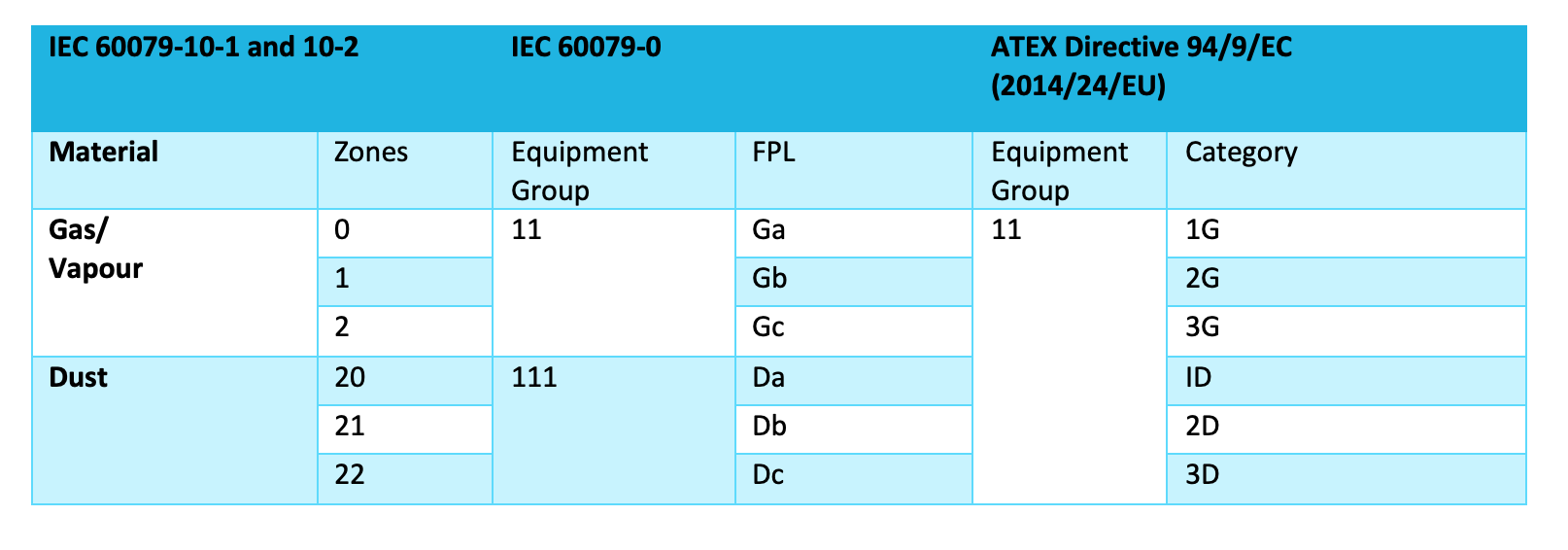
Where only the zones are identified in the area classification documentation, then the relationship between categories/EPLl s and zones from Table 5 should be followed.
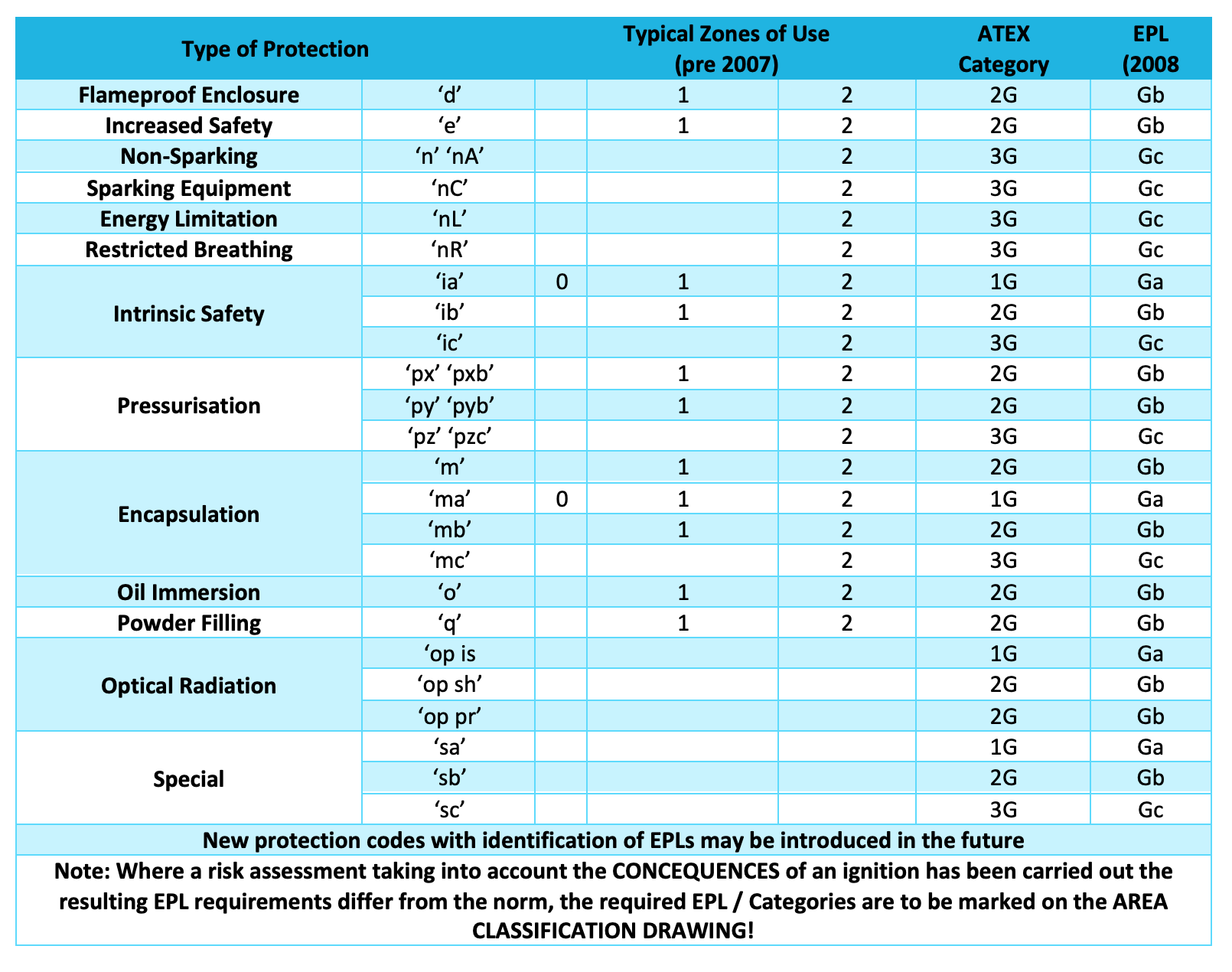
However where a risk assessment, taking into account the consequences of an ignition, has been carried out and the resulting EPL requirements differ from the norm for that zone, the required EPL/ ATEX Category is to be marked on the Area Classification Drawing.
Note: In the EU, it is a requirement that al/ new equipment installed after July 2003 complies with A TEX, hence the equipment must be marked with the Category.Further details on each type of protection can be found in Sections 3.2 to 3.11.
Table 5: Relationship between Zones, Equipment
Groups, Equipment Protection Levels (EPLs) and ATEX Categories
3.1.3 Explosion Protection Concepts
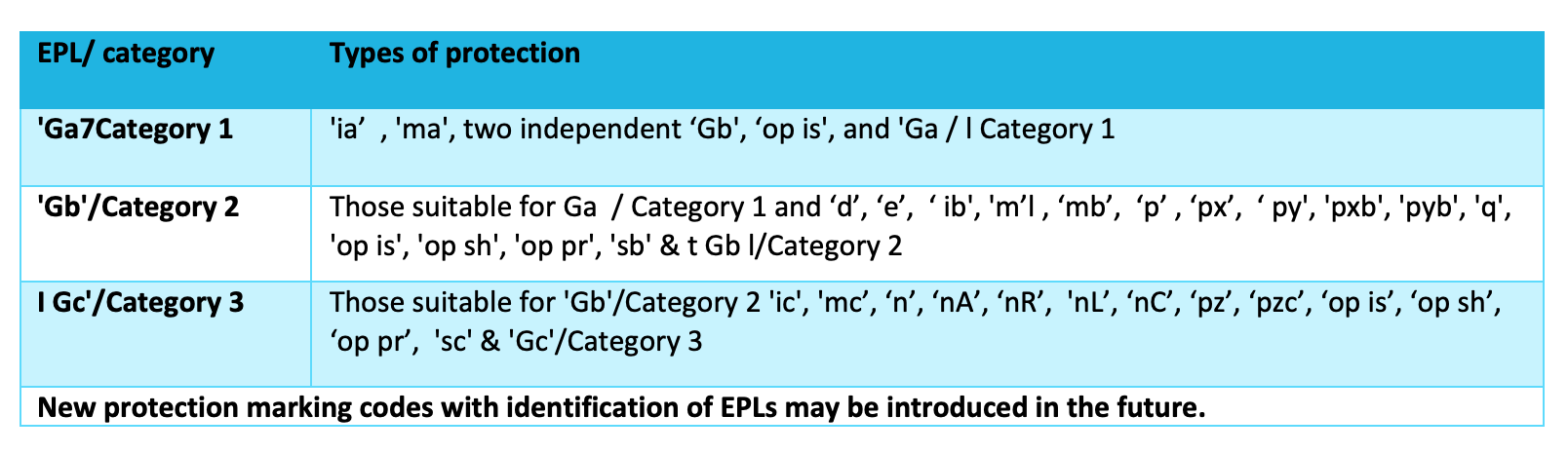
A number of different types of construction methods can be used to minimise the possibility of electrical equipment being capable of igniting a surrounding flammable atmosphere.
Table 6: Type of Protection which may be used based on EPL/Category requirements
3.1.4 Ex components
An Ex component is a part of electrical equipment or a module (other than an Ex cable gland) which is not intended to be used alone and requires additional consideration when incorporated into electrical apparatus or systems for use in explosive gas atmospheres. Ex components are marked with the symbol 1 13 1. Examples of Ex components include an approved but empty enclosure, a type ‘d’ pushbutton switch or a type ‘e’ terminal block.
Ex enclosures and components having only a component certificate, which are marked with a ‘u’, shall not be installed in the hazardous area unless they are part of an assembly of components (now being referred to as an equipment) when the components in the equipment are permitted by a complete (equipment) Ex certificate. Such a certificate may have a suffix X(specific conditions of use - see section 3.14.1). The equipment label will carry the full Ex marking including the temperature class.
Only Ex equipment (other than simple apparatus) having a complete (equipment) certificate shall be installed in the hazardous area.